Expert Chiropractic and Regenerative Medicine for our patients so they can get back to work and the things they love to do.
Platelet-Rich Plasma: How It Works and What Patients Can Actually Expect
August 27, 2026Platelet-rich plasma (PRP) has moved from a niche sports-medicine curiosity to a mainstream option in orthopedics, dermatology, and aesthetic medicine. It shows up in conversations about knee arthritis, tennis elbow, hair thinning, and “vampire facials” alike. But despite its popularity, PRP is often marketed with more confidence than the evidence supports. This post breaks down what PRP actually is, how it’s thought to work at the cellular level, and what the current research says about outcomes across its most common uses.
What Is PRP?
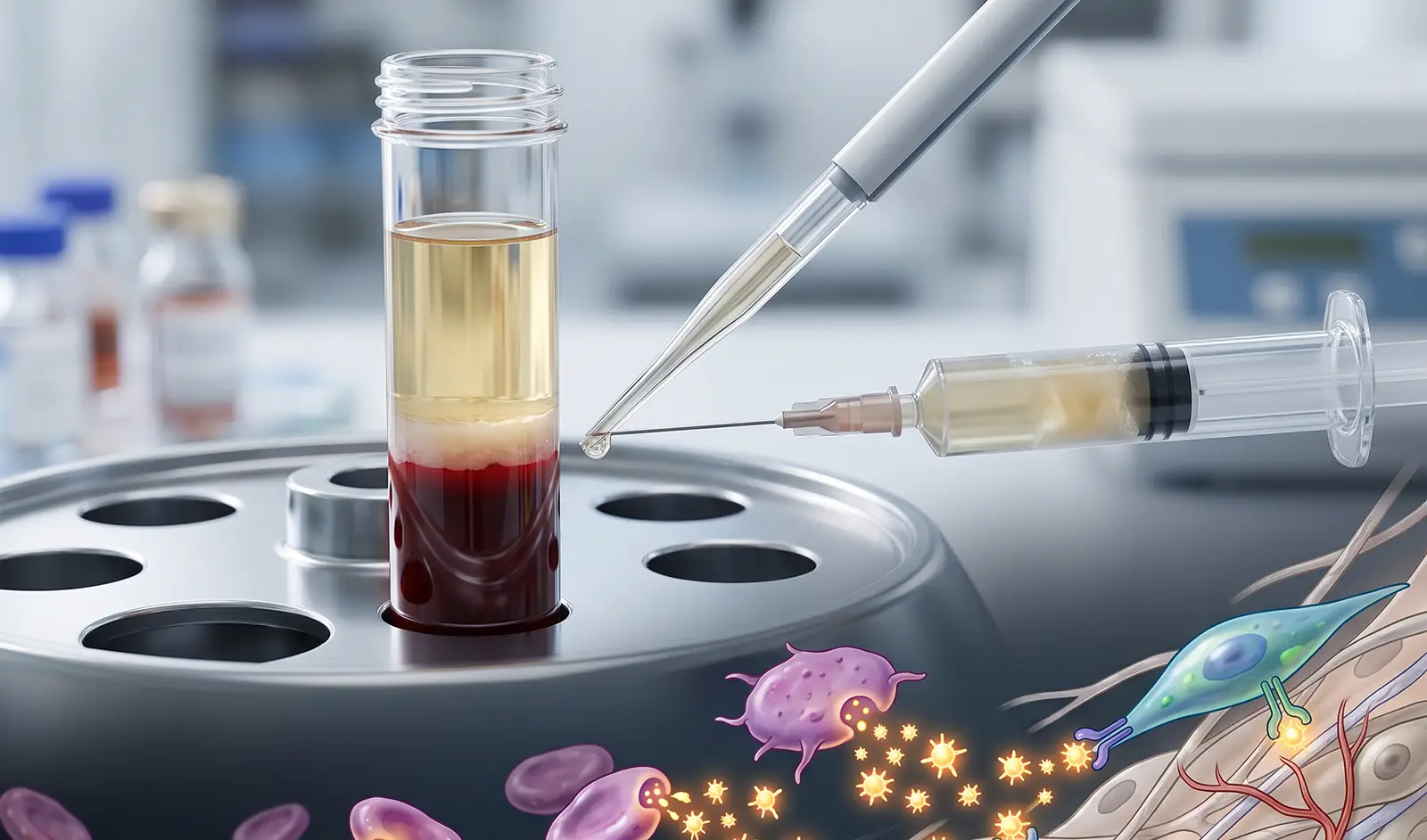
PRP is derived from a patient’s own blood. A sample is drawn, then spun in a centrifuge to separate it into layers by density. The platelet-rich layer is drawn off and injected back into the patient at the site of injury or concern — a joint, a tendon, the scalp, or the skin. Because it comes from the patient’s own body, PRP is considered autologous, which minimizes the risk of allergic reaction or disease transmission compared to synthetic or donor-derived products.
Not all PRP is the same. Preparations vary by platelet concentration, whether white blood cells (leukocytes) are included and the specific centrifugation protocol used. This variability matters — it’s one of the biggest reasons research findings on PRP are inconsistent from study to study.
The Mechanism of Action
Platelets are best known for their role in clotting, but they’re also packed with tiny storage compartments called alpha-granules. These granules hold a cocktail of growth factors and signaling molecules that platelets normally release at the site of an injury as part of the body’s natural repair process. PRP therapy is essentially an attempt to concentrate and deliver a large, localized dose of that same biological machinery.
When platelets in PRP are activated — either by contact with collagen in damaged tissue or by an added activating agent — they degranulate and release factors including:
- Platelet-derived growth factor (PDGF) — stimulates cell proliferation and recruits repair cells to the injury site
- Transforming growth factor-beta (TGF-β) — plays a central role in cartilage and connective tissue regeneration by promoting stem cell differentiation into chondrocytes and fibroblasts, while also countering inflammatory signals like IL-1
- Vascular endothelial growth factor (VEGF) — drives angiogenesis, or the formation of new blood vessels, which supports tissue healing
- Epidermal growth factor (EGF) and fibroblast growth factor (FGF) — support cell migration, matrix synthesis, and tissue remodeling
- Insulin-like growth factor-1 (IGF-1) and hepatocyte growth factor (HGF) — additional plasma-derived signals linked to cell proliferation
These molecules act on the membrane receptors of nearby cells — including mesenchymal stem cells, fibroblasts, and endothelial cells — triggering proliferation, migration, and differentiation. In addition to growth factors, PRP preparations that retain white blood cells contribute immune-modulating effects, and emerging research points to exosomes (tiny vesicles that carry signaling cargo between cells) as another mechanism by which PRP influences surrounding tissue.
It’s worth being direct about a limitation here: researchers still describe the exact mechanism of PRP as “not fully understood.” The broad strokes — growth factor release, stem cell recruitment, modulation of inflammation — are well supported in lab and animal studies. Translating that biology into consistent, measurable clinical benefit in humans has proven more difficult, largely because of the preparation variability mentioned above.
What the Outcomes Data Actually Shows
Expected outcomes vary considerably by condition. Here’s a realistic, evidence-based breakdown of where PRP currently stands.
Knee Osteoarthritis — Strongest Evidence
This is PRP’s best-supported application. Recent meta-analyses (2024–2025) consistently show that PRP injections — particularly “leukocyte-poor” formulations — produce greater improvements in pain and function than hyaluronic acid or corticosteroid injections, especially in mild-to-moderate osteoarthritis. Benefits are typically seen within a few weeks and, in some trials, have been shown to persist through 12 months. PRP appears to be a symptomatic treatment rather than a disease-modifying one: it doesn’t reliably show structural improvement on MRI, but it does measurably improve pain and function scores.
Rotator Cuff and Achilles Tendinopathy — Moderate, Mixed Evidence
Some meta-analyses report superior functional outcomes and reduced re-tear rates with PRP for rotator cuff repair augmentation, and modest short-term pain improvement for Achilles tendinopathy. However, an umbrella review of Achilles tendinopathy studies found that most systematic reviews showed no statistically significant difference from control treatments, with any short-term gains failing to reach clinical significance or persist long-term.
Lateral Epicondylitis (Tennis Elbow) — Genuinely Mixed
This is one of the clearer examples of inconsistent evidence in the PRP literature. Some large randomized trials report superior pain relief and function versus placebo, while a Cochrane review found no meaningful benefit over placebo. If you’re considering PRP for this condition, it’s worth having a candid conversation with your provider about the uncertainty.
Androgenetic Alopecia (Hair Loss) — Promising, Protocol-Dependent
A 2025 systematic review and meta-analysis of 43 randomized controlled trials found that activated PRP meaningfully increased hair density and reduced recurrence compared to placebo, while non-activated PRP carried a higher rate of side effects. Results depend heavily on activation protocol, platelet concentration, and injection frequency — this is not a “one and done” treatment, and most protocols involve a series of sessions followed by maintenance.
Aesthetic / Facial Rejuvenation — Real but Modest
PRP facials and micro-needling combinations are widely marketed, but the evidence base here is thinner and effect sizes tend to be modest compared to orthopedic or hair-loss applications. Patients should calibrate expectations accordingly — PRP is not a substitute for more established aesthetic procedures when significant change is the goal.
Practical Takeaways
A few threads run through the research regardless of the specific condition:
- Preparation matters enormously. Platelet concentration, leukocyte content, and activation method all affect outcomes, and studies using different protocols aren’t always comparable. Some research suggests a platelet concentration threshold (often cited around 1 million platelets/µL) is needed for clinically meaningful benefit.
- PRP treats symptoms, not necessarily structure. For joint and tendon applications, most evidence points to improved pain and function rather than visible tissue regeneration on imaging.
- Timing and patient selection affect success. Earlier-stage disease (e.g., mild-to-moderate osteoarthritis rather than advanced/bone-on-bone) tends to respond better.
- It’s not risk-free, but it’s low-risk. Because PRP is autologous, the most common side effects are localized — pain, swelling, or bruising at the injection site — rather than systemic allergic or immune reactions.
- Evidence quality varies by condition. Knee osteoarthritis and plantar fasciitis have the strongest support; tennis elbow and Achilles tendinopathy remain genuinely contested; facial rejuvenation applications are the least well-studied.
The Bottom Line
PRP’s underlying biology — using a concentrated dose of the body’s own growth factors to accelerate healing — is sound and well-documented at the cellular level. Where the story gets more complicated is in translating that biology into consistent clinical results, largely because “PRP” isn’t one standardized product but a family of preparations that vary by concentration, cell content, and activation method. For knee osteoarthritis and plantar fasciitis, the evidence for meaningful benefit is fairly strong. For tendon conditions like tennis elbow, and for aesthetic applications, the picture is more mixed, and expectations should be set accordingly.
As with any regenerative or biologic therapy, the best approach is to discuss your specific condition, the clinic’s preparation protocol, and realistic expected outcomes with a qualified provider before starting treatment.
© 2026 Opdahl Chiropractic & Massage